The ultimate measure of an underwriting tool’s efficacy is its “protective value.” It represents the quantifiable mortality savings achieved by accurately identifying and pricing risks that might otherwise be missed. The sophisticated, condition-focused rules engine within ExamOne’s Risk Identifier provides a holistic view of an applicant, delivering a financial and risk management benefit that makes full use of all available data sources, with notably low levels of redundancy.
A granular analysis of our data demonstrates the dramatic financial impact of this holistic view. When viewed in isolation, a single data source like prescription history yields a protective value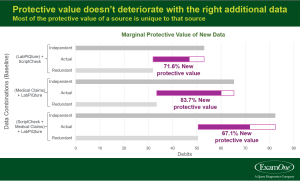 of approximately $1,303 on a standard policy. However, when this information is fused with clinical and life insurance lab data and medical claims through ExamOne’s Risk Identifier, the protective value more than triples, climbing to $4,435.
This substantial increase stems from the unique, minimally overlapping insights each data source provides; our analysis shows that even when prescription and claims data are already in use, 67.1% of the total protective value of lab data is entirely new to the underwriting process. This principle is best illustrated through a practical underwriting scenario that Risk Identifier is built to solve. Consider two 45-year-old male applicants who both disclose a history of diabetes and treatment with metformin. On paper, they present a similar risk. Yet, the integration of historical A1c lab data within ExamOne’s Risk Identifier reveals a crucial distinction: one applicant’s A1c of 6.6% points to a well-managed condition, warranting a recommended table-rating approval. The other’s A1c of 11.2% signals a poorly controlled, high-risk profile that may necessitate a decline or RUW. This insight, available only through the synthesis of data within Risk Identifier, directly prevents antiselection and protects against significant mortality costs.
Ultimately, this integrated and condition-focused approach delivers a superior and quantifiable return on investment. The multidimensional and accurate view of risk provided by ExamOne’s Risk Identifier directly enhances the bottom line through a demonstrable increase in protective value.
To learn more about ExamOne’s Risk Identifier and how it can fit into your workflow, contact your Strategic Account Executive or request a meeting here.







The ultimate measure of an underwriting tool’s efficacy is its “protective value.” It represents the quantifiable mortality savings achieved by accurately identifying and pricing risks that might otherwise be missed. The sophisticated, condition-focused rules engine within ExamOne’s Risk Identifier provides a holistic view of an applicant, delivering a financial and risk management benefit that makes full use of all available data sources, with notably low levels of redundancy.
A granular analysis of our data demonstrates the dramatic financial impact of this holistic view. When viewed in isolation, a single data source like prescription history yields a protective value of approximately $1,303 on a standard policy. However, when this information is fused with clinical and life insurance lab data and medical claims through ExamOne’s Risk Identifier, the protective value more than triples, climbing to $4,435.
This substantial increase stems from the unique, minimally overlapping insights each data source provides; our analysis shows that even when prescription and claims data are already in use, 67.1% of the total protective value of lab data is entirely new to the underwriting process. This principle is best illustrated through a practical underwriting scenario that Risk Identifier is built to solve. Consider two 45-year-old male applicants who both disclose a history of diabetes and treatment with metformin. On paper, they present a similar risk. Yet, the integration of historical A1c lab data within ExamOne’s Risk Identifier reveals a crucial distinction: one applicant’s A1c of 6.6% points to a well-managed condition, warranting a recommended table-rating approval. The other’s A1c of 11.2% signals a poorly controlled, high-risk profile that may necessitate a decline or RUW. This insight, available only through the synthesis of data within Risk Identifier, directly prevents antiselection and protects against significant mortality costs.
Ultimately, this integrated and condition-focused approach delivers a superior and quantifiable return on investment. The multidimensional and accurate view of risk provided by ExamOne’s Risk Identifier directly enhances the bottom line through a demonstrable increase in protective value.
To learn more about ExamOne’s Risk Identifier and how it can fit into your workflow, contact your Strategic Account Executive or request a meeting here.