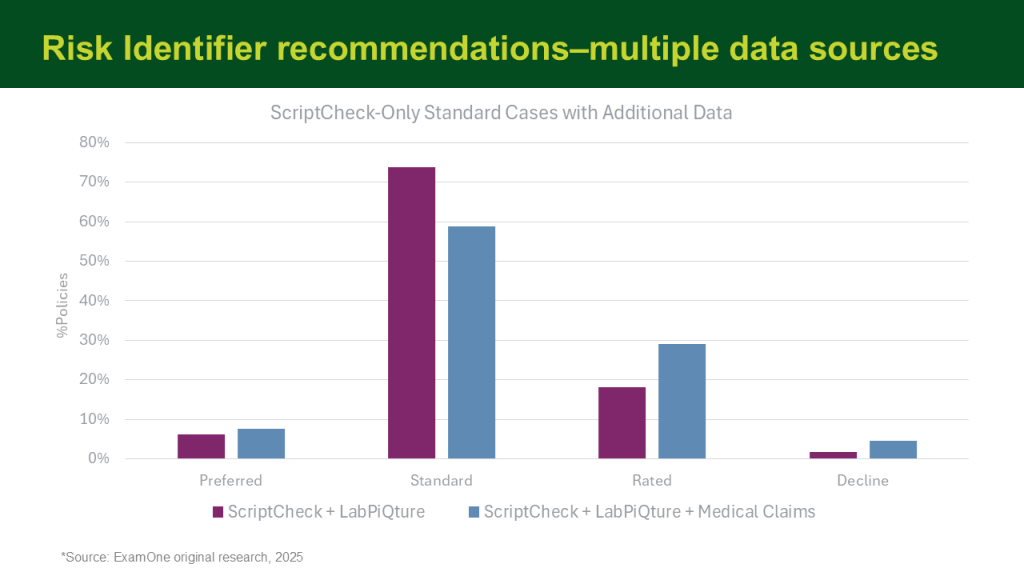
 The power of Risk Identifier lies in its ability to move beyond a single, final output. It creates a detailed risk profile by synthesizing prescription, lab, and medical claims data and then applies a transparent debit/credit score to the combined findings. This is the core of its stratification capability. For instance, instead of simply flagging “diabetes,” Risk Identifier can differentiate between a well-managed case with consistently low A1c levels (a lower debit score) and a case with evidence of complications and high A1c readings (a significantly higher debit score). This creates distinct, data-supported risk strata from what might appear as a single condition on an application.
This granular segmentation has important implications for underwriting. First, it enables highly efficient workflow optimization. Applicants falling into the lowest risk strata can be confidently fast-tracked through accelerated or automated underwriting pathways, reducing turnaround times and acquisition costs. This frees experienced underwriters to dedicate their expertise to the complex, high-value cases in the upper risk tiers, where their manual review adds the most value.
Furthermore, precise stratification is the foundation of accurate pricing. By moving from broad risk classes to finely-tuned tiers, carriers can align premiums more closely with the specific risk presented by each applicant. This improves profitability on higher-risk policies and allows for more competitive pricing on lower-risk segments, preventing the adverse selection that occurs when a single, broad price is offered to a wide range of risks. Ultimately, ExamOne’s Risk Identifier provides the tool to not just identify risk, but to price it with a new level of precision, building a more predictable and profitable book of business.
To learn more about ExamOne’s Risk Identifier and how it can fit into your workflow, contact your Strategic Account Executive or request a meeting here.







This granular segmentation has important implications for underwriting. First, it enables highly efficient workflow optimization. Applicants falling into the lowest risk strata can be confidently fast-tracked through accelerated or automated underwriting pathways, reducing turnaround times and acquisition costs. This frees experienced underwriters to dedicate their expertise to the complex, high-value cases in the upper risk tiers, where their manual review adds the most value.
Furthermore, precise stratification is the foundation of accurate pricing. By moving from broad risk classes to finely-tuned tiers, carriers can align premiums more closely with the specific risk presented by each applicant. This improves profitability on higher-risk policies and allows for more competitive pricing on lower-risk segments, preventing the adverse selection that occurs when a single, broad price is offered to a wide range of risks. Ultimately, ExamOne’s Risk Identifier provides the tool to not just identify risk, but to price it with a new level of precision, building a more predictable and profitable book of business.
To learn more about ExamOne’s Risk Identifier and how it can fit into your workflow, contact your Strategic Account Executive or request a meeting here.